

In every marginally successful Olympics opening ceremony, there is a moment when you realize you’ve stopped chuckling at the self-serious interpretive dance of it all and wholeheartedly bought in. For me, in Friday’s painfully long, inevitably uneven, excessively dance-obsessed but also somehow lovable Milan Cortina 2026 event, that moment came early. (I’m glad it didn’t happen after the three-hour mark, because by then I could barely keep my eyes open.) A figure appeared in an evening gown, trailed by a phalanx of paparazzi—a witty, concise tribute to La Dolce Vita, the classic of Italian cinema whose pesky photographer character, Paparazzo, inspired the term. A master of spectacle, craftsmanship, and glamour (not to mention a devotee of generous runtimes), the film’s director, Federico Fellini, might well have been a guiding influence on this ceremony whose celebration of the art and culture of Italy felt defiantly analog.
[time-brightcove not-tgx=”true”]
Helmed by veteran producer Marco Balich and aired live in the U.S. on NBC and Peacock (both of which are rerunning Friday night), the extravaganza mostly played out before a crowd of some 80,000 spectators at Milan’s San Siro Stadium, with satellite gatherings in other locations hosting various events. The multiple locations—and, for the first time in Olympic history, dual cauldrons, in Milan and the mountain town of Cortina—could be a bit disorienting, especially with the Parade of Nations splitting up delegations of athletes. But it all pretty much made sense in service of the ceremony’s stated theme: armonia, or harmony. What could be more symbolic of a world uniting in divisive times than literally splicing together a handful of geographically separate events for a global audience to consume as a more or less cohesive whole?
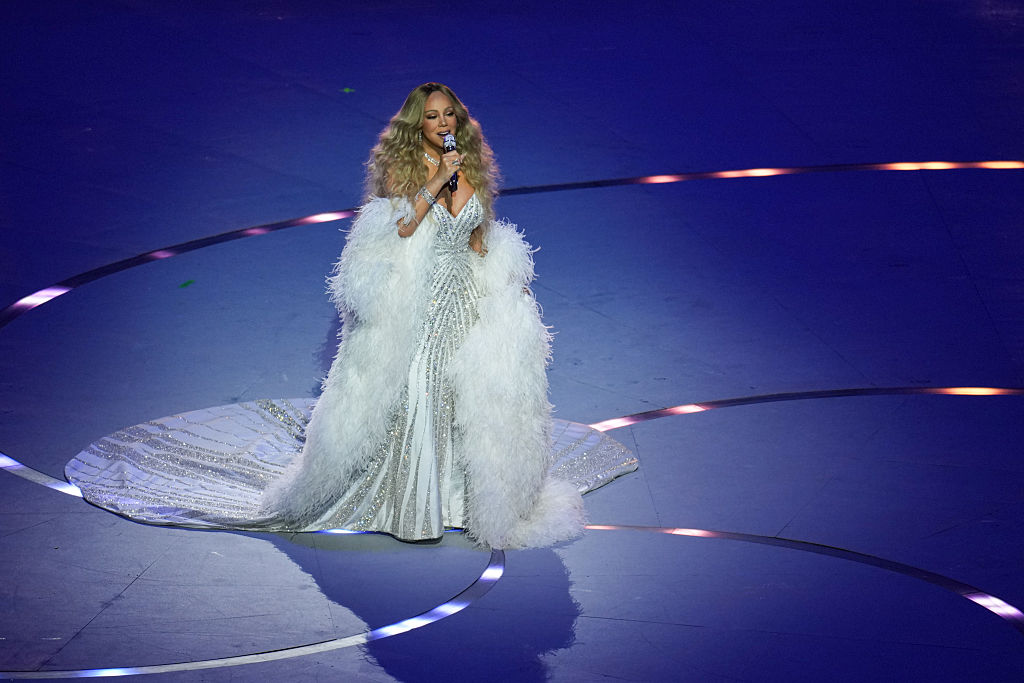
As we’ve come to expect from opening ceremonies, the performances juggled high art (poetry! opera!) and meme-worthy camp. After an opening video that could’ve been an Italian tourism ad (mountains, cafes, fashionistas), dancers in white and silver togas took the circular stage at San Siro for an homage to Italian sculptor Antonio Canova’s Psyche Revived by Cupid’s Kiss, which, of course, takes as its subject the Roman mythology that is also part of Italy’s heritage. The paparazzi scene gave way to a ridiculous—but fun!—vignette involving cartoonishly oversized masks of the Italian composers Rossini, Puccini, and Verdi. Giant paint tubes swung from the ceiling, squeezing out bright streams of fabric. In a particularly Felliniesque touch, dozens of brightly colored dancers appeared in costume as various items of Italiana: Colosseums, espresso pots, bakers carrying tiered cakes. Marquee performer Mariah Carey, perhaps our greatest human fusion of art and camp, soon appeared, swaddled in white feathers, to perform the Italian-language standard “Volare” (and shoehorn in a passage of her own song “Nothing Is Impossible,” naturally). Giorgio Armani, the iconic Milanese designer who died last fall, would likely have appreciated a stylishly minimalistic tribute that had three lines of models march through the arena dressed in monochromatic Armani suits in the colors of the Italian flag.
The pileup of performances and interstitial videos eventually got old. Did we need to see that one clip of athletes, musicians, and giggling children gliding around the city in streetcars? Probably not. Or the cartoon rendering of the wonderful Italian actress Sabrina Impacciatore (known stateside as a highlight of The White Lotus and The Paper) flying back in time through Olympic logos? No, but the live-action production number that followed, bringing the bewildered Impacciatore back to the future through decades of sweater-clad hockey players and neon ’80s skiers, was an absolute blast. I cannot say the same of the obligatory musical plea for peace, a vague, somber song and dance punctuated by, why not, Charlize Theron quoting Nelson Mandela; at a time like this, an anodyne message about the state of the world can feel more insensitive than no message at all. And to think: around two-and-a-half hours earlier, I’d optimistically wondered if the umpteenth interminable pre-Parade of Nations dance—the one that ever-so-slowly led up to the ascension of the Olympic rings—might be the last we would have to endure. As it turned out, there were still more dances to come after the Charlize bit.
What I did like about the number with the rings, though, was the way it epitomized this opening ceremony’s subtly low-tech aesthetic. The rings that, to all the world, represent the Olympics were massive physical structures lit up by fireworks—that ancient technology. The drone displays and Minion cameos and technological one-upmanship that has defined this event in the 2020s were not the focus this time. An obvious choice would have been to trick out the ceremony with flashy, perhaps sponsored deployments of AI. Instead, Milan made the moving choice to honor that essential ingredient of both the arts and athletic achievement: humanity.