

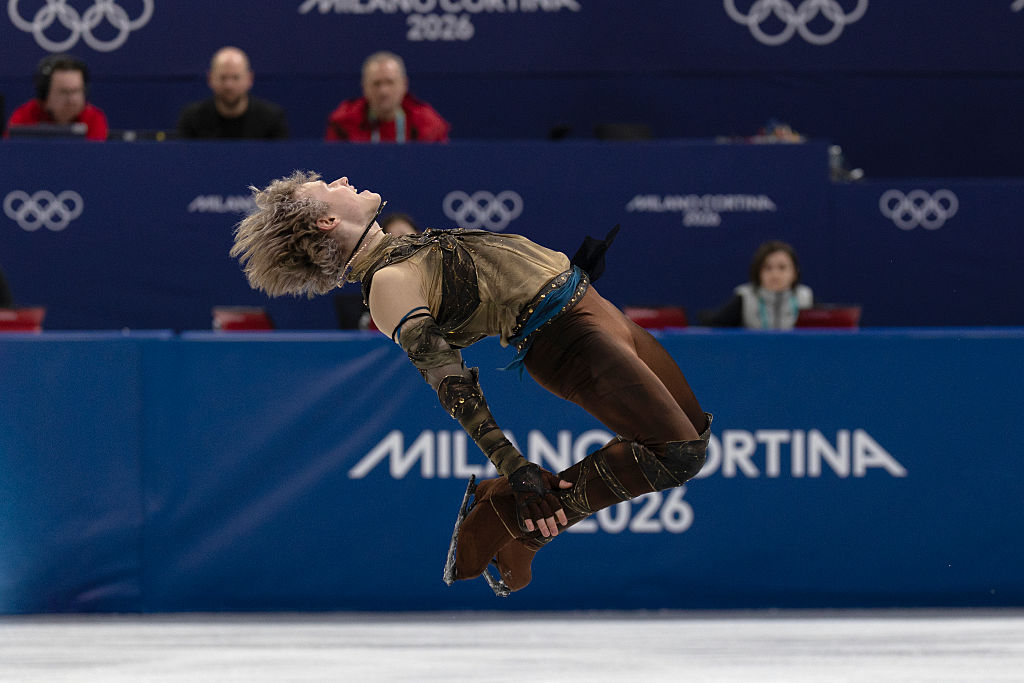
The Milano Ice Skating Arena was packed with skating fans who braved the crowded 40 minute metro ride from central Milan to watch the short program of the 2026 Winter Olympics’ men’s figure skating competition. And there was likely one person they all wanted to see—the “quad god” himself, Ilia Malinin.
[time-brightcove not-tgx=”true”]
Malinin has already competed twice in Milan, in the short and free programs in the team event, and helped the U.S. prevail over Japan by one point to win his first Olympic medal: gold.
This time, he had just himself to worry about.
Before taking his starting position, Malinin filled his cheeks with air and exhaled deeply several times. As he had in the team event, he opted to switch out the quadruple axel planned for his first jump for a quadruple flip, easily completing the four turns in the air before landing solidly. He followed that with a triple axel and a camel spin. Then came the biggest-scoring jump combination of the entire night, and his second quad—a quadruple lutz and triple toe loop that earned him 22.03 points. None of the other 28 athletes received over 20 points for any of their jumps. Knowing he had completed his last challenging skill, Malinin pumped his fist in the air, and by the boards, Rafael Arutunyan, who coached 2022 Olympic men’s champion Nathan Chen and has worked with Malinin, slapped Malinin’s father and coach, Roman Skorniokov, on the back several times in celebration.
From there, it was a victory lap of sorts for Malinin, including a backflip—now one of his signature moves—that brought a roar of appreciation from the crowd. As he took his final pose, the audience rose to its feet with deafening applause.
“I really felt like I could enjoy the program and the story behind it and I was definitely having fun,” he said. “I felt a little more calm, and just pushed the autopilot button to see what happens.”
Read more: U.S. Wins the First Figure Skating Event of the Milano Cortina Olympics
Malinin’s autopilot, though, is the equivalent of revving full throttle for other skaters, and his score proved it. In addition to the nearly six additional points he collected over the second place finisher, Japan’s Yuma Kagiyama, in technical elements, he received a perfect 10.0 score from one judge for his presentation of those challenging skills set to the theme from Prince of Persia: The Lost Crown, an action-adventure game. “It’s one thing to do everything in practice, but it’s another skill to be able to perform it under pressure,” he said. “That’s something I really enjoy.”
Malinin admitted that the enormity of being at the Olympics overwhelmed him during the short and long programs he competed in during the team event, and while he helped Team USA to win gold, the performances weren’t up to his usual standards. “I definitely think it was a good idea to do [both the short and free programs in] the team because I think just the short program wouldn’t have been enough to get comfortable with the ice.”
It wasn’t just Malinin who had a solid skate on Tuesday. His teammates, Andrew Torgashev and Maxim Naumov, who skated ahead of him, performed among the best routines of their careers, with Torgashev finishing eighth and Naumov 14th. Naumov, the second athlete to skate, received a rousing roar of applause as he was introduced—the well-informed skating crowd knew about his unique journey to the Olympics, after his parents and coaches were killed in a plane crash in January 2025 returning home from a skating competition. Naumov wasn’t sure he would skate again, but started by lacing up his skates to continue coaching young skaters in the program his parents had created at the Skating Club of Boston. Supported by his parents’ long-time friends Elena and Vladimir Petrenko, their sons, and his god parents, Naumov decided last summer to skate competitively again, and fulfill his and his parents’ dream of competing at the Olympics.
They were all in the Milano Ice Skating Arena as Naumov’s name was called for the warm up—Vladimir, whom Naumov asked to coach him, was with Naumov rinkside, while Elena; her two sons, Daniel and Anton, who are like brothers to Naumov; Nickolai Serebriakov, his god brother; Victoria Zysk, Daniel’s fiancée; and Katie Orscher Moesgaard, a U.S. pairs champion who was coached by Shishkova and Naumov, cheered him from the second tier.
Elena, a skating coach and choreographer, was on the edge of her seat throughout Naumov’s program, quietly miming his movements in the arena’s second tier above the rink, willing Naumov on with every piece of choreography. “Easy, easy,” she said as the neared the end of his routine. “One more, one more,” she whispered before his last spin, finally allowing herself to breathe a sigh of relief when Naumov hit his last pose. “We did it, we did it. This is what he wanted,” she said. Looking at her husband as he waited for Naumov to come off the ice, she said, “He’s crying.”
“I felt like I was guided by them today, feeling their presence with every glide that I made on the ice,” Naumov said of his parents. As he did at the U.S. national championships in January, while waiting for his scores in the kiss and cry area, Naumov held up a picture of his first time on the ice at three years old, flanked by his parents, because he wanted to feel that they were there with him. “I couldn’t help but feel their support, almost like a chess piece on a chess board, just from one element to another.”
Read more: A Year After Losing His Parents in a Plane Crash, Maxim Naumov Makes His Olympic Debut
One of the last conversations Naumov had with his parents was about this Olympic season, and the plan for making his first Olympic team. A big part of that was increasing the difficulty of his elements to the highest level, level 4, on his spins and step sequences. After deciding to skate again to achieve his and his parents’ Olympic dream, he worked tirelessly for four months—not a long time in the skating world—to reach those standards. He did that in Milan, and his score was enough to qualify him to compete in the final portion of the men’s program, the free skate, on Feb. 13.
“I finished on my knees and I didn’t know if I was going to cry, smile or laugh,” said Naumov. “And all I could do was just look up and say, ‘look what we just did.’ I said it in English, I said it in Russian. And it’s true. We did it together.”
Several minutes later, Naumov’s teammate Andrew Torgashev skated to a new personal best score and finished the short program in eighth place, which also qualified him to compete in the free program final.
Malinin was the next to last to skate, and the crowd roared when he was introduced for the warm up. As nerve-wracking as it might be to be alone on the ice, with not just tens of thousands of people watching in the arena, but multiple times more on TV, Malinin says he welcomes the attention, and the pressure. “I definitely love the pressure,” he said. “It’s not just the thrill of figure skating, but the competition itself—going out here, preparing yourself so well, and having all that attention, all those eyes on you, that pressure really shows you who you truly are.”
And now the world knows who Ilia Malinin really is. The quad god.