

The world’s largest-ever AI summit took place in India this week, with hundreds of thousands of people, including world leaders and CEOs of AI companies, descending upon New Delhi for five days.
It was the fourth in a series of summits that were initially designed as a place for governments to coordinate global action in the face of threats from advanced AI.
[time-brightcove not-tgx=”true”]
But the India summit, like one in Paris before it, functioned more as a trade fair and an advertisement for the host nation’s AI prowess than a venue for meaningful international diplomacy.
China, the world’s second largest AI power and India’s strategic adversary, was all but absent from the summit, which fell on the same week as Chinese New Year.
And official statements released during the summit made no overt mention of previous summits’ attempts to coordinate government action on addressing AI risks. Instead, a set of voluntary commitments announced by the Indian government emphasized the importance of sharing data on real-world AI usage and building mechanisms to improve AI in under-represented languages.
“Full global consensus on how to govern AI is a far cry from reality,” says Isabella Wilkinson, a research fellow at the British foreign affairs think-tank Chatham House. “The core issue is how to incentivize countries and companies to get around the same table … despite fragmented geopolitics, intense competition, and the drive for ever-more powerful and -profitable AI. None of this is particularly conducive to global cooperation.”
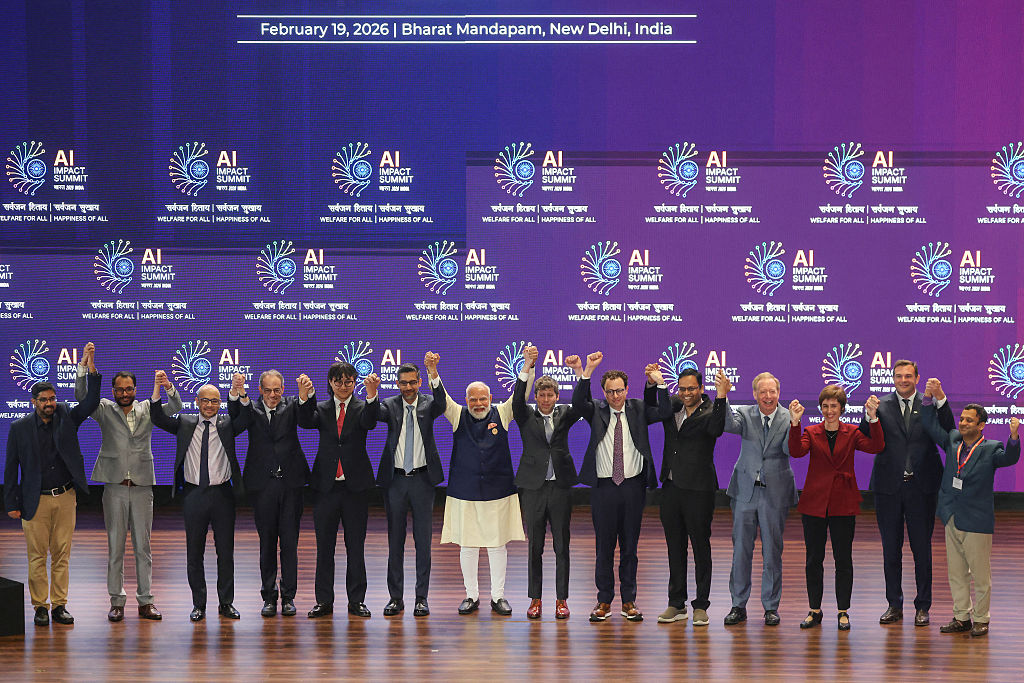
The event’s host, Indian Prime Minister Narendra Modi, was pictured on Thursday with a lineup of the AI world’s most powerful figures, including OpenAI CEO Sam Altman, Anthropic CEO Dario Amodei, and Google DeepMind CEO Demis Hassabis, among others. Many AI companies announced significant deals and partnerships with Indian companies over the course of the week, underlining the event’s growing power as a venue for serious moneymaking. And India touted its domestic tech industry, and its government-run digital public infrastructure, as ostensible evidence of its ability to stake out on its own in the AI race, without relying on foreign technology.
The event was widely criticized for what many said was its chaotic organization, including widespread road closures for VIP motorcades that caused traffic snarls across the city. Huge crowds at the venue — which was open to the public on its first couple of days — contributed to long queues and some delegates being unable to attend their panels. In an apt metaphor for the gender balance of AI as a whole, the “ladies’ queues” for security were far shorter than the men’s. And despite the huge crowds on earlier days, the CEOs of OpenAI, DeepMind, and Anthropic delivered their remarks to a more than half-empty hall on Thursday, after entry to the venue was restricted at short notice, apparently for security reasons.
Those executives — in dealmaking mode — largely focused their keynotes on India’s huge potential to reap the benefits of AI, and its pedigree in building digital public infrastructure that has improved the lives of its 1.4 billion citizens. And they praised India’s vast tech workforce, which they said had a voracious appetite for building with their tools. Amodei, the CEO of Anthropic, claimed that advanced AI might lead to 25% annual GDP growth for India, compared to 10% for rich countries. (He conceded those numbers might “sound absurd.”)
But the executives also warned of massive, and potentially perilous, changes on the horizon. Altman, the CEO of OpenAI, claimed the world might just be “only a couple of years away from early forms of superintelligence,” raising the specter of a global totalitarian regime that he said must be averted by democratizing and decentralizing AI development. Hassabis, the CEO of Google DeepMind, said artificial general intelligence (AGI) could be achieved within five years — an apparent halving of his projected timeline last year, when he said he expected AGI within five and 10 years.
The event was the first AI summit to be held in the Global South, and much of the Indian government’s focus was on the developmental and economic opportunities that it said AI is already creating across the subcontinent. Government posters plastered across Delhi declared that “For India, AI stands for ALL INCLUSIVE.” The event’s tagline — “Welfare for all, Happiness of all” — underscored a shift in focus away from just AI risks and toward the ostensible benefits that AI might bring to the world’s poorest.
“There would be no credible AI summit in the West that had that tagline,” Rumman Chowdhury, CEO of the AI auditing startup Humane Intelligence, tells TIME. “One thing I like about this framing is that it’s pushing the narrative to say: it’s credible to talk about happiness, welfare, and flourishing.”
But for all its focus on inclusion and development, some delegates wondered aloud whether the Indian government was only posturing. Little mention was made of the possibility that India’s vast technology workforce might be uniquely vulnerable to dislocation by AI tools like Claude Code and Claude Cowork, and their competitors, that AI CEOs touted during their keynote addresses. “Lots of correct words were used to feed an insidious narrative of inevitability,” says Mishi Choudhary, a technology lawyer and civil liberties activist. “I am still waiting for discussions on job eliminations, power infrastructure, and impact on artists.”
The hierarchy of the event was also hard to miss, with homeless people reportedly evicted from the road leading to the venue and VIP motorcades shutting down the city with little regard for its residents. The eviction of an Indian university from the summit’s sprawling expo space — for passing off a Chinese-manufactured robot dog as a domestic innovation — seemed to underline the feeling that for all India’s talk of AI sovereignty, most AI computing power, data, and talent, remains highly concentrated in the U.S. and China.
That uncomfortable truth was on the minds of many delegates who discussed the growing sense of strategic fear among so-called “middle powers,” like Europe, Canada, and India, who have been rattled by President Donald Trump’s recent actions on the world stage. After Trump threatened to take Greenland by force and called the NATO alliance into doubt, many U.S. allies have been forced to rethink their dependence on American security and technology. In Delhi, there was a growing awareness by middle powers of the need to build their own AI capability — whether in training their own models, designing their own chips, or extricating themselves from the convenient but risky grip of Silicon Valley software giants.
Attending the summit, White House representative Michael Kratsios addressed middle powers’ fears. “Real AI sovereignty means owning and using best-in-class technology for the benefit of your people,” he said. “Complete technological self-containment is unrealistic for any country, because the AI stack is incredibly complex. But strategic autonomy alongside rapid AI adoption is achievable, and it is a necessity for independent nations. America wants to help.”
“America is the only AI superpower willing and able to truly empower partner nations in your pursuit of meaningful AI sovereignty,” he went on. “American companies can build large, independent AI infrastructure, with secure and robust supply chains that minimize backdoor risk. They build it; it’s yours.”
Be that true or false, American allies may have little choice in the matter — and as a result, global governmental action on AI may be a moot point. “The production, the development, and the deployment of these [frontier AI] systems is just so heavily concentrated. It happens to only happen in the U.S. and a little bit in China, and basically nowhere else,” says Anton Leicht, a visiting scholar at the Carnegie Endowment for International Peace. “So just from a leverage point of view, there isn’t any forcing function to coordinate any global conversation. … You don’t really need much of the rest of the world to weigh in on this.”