

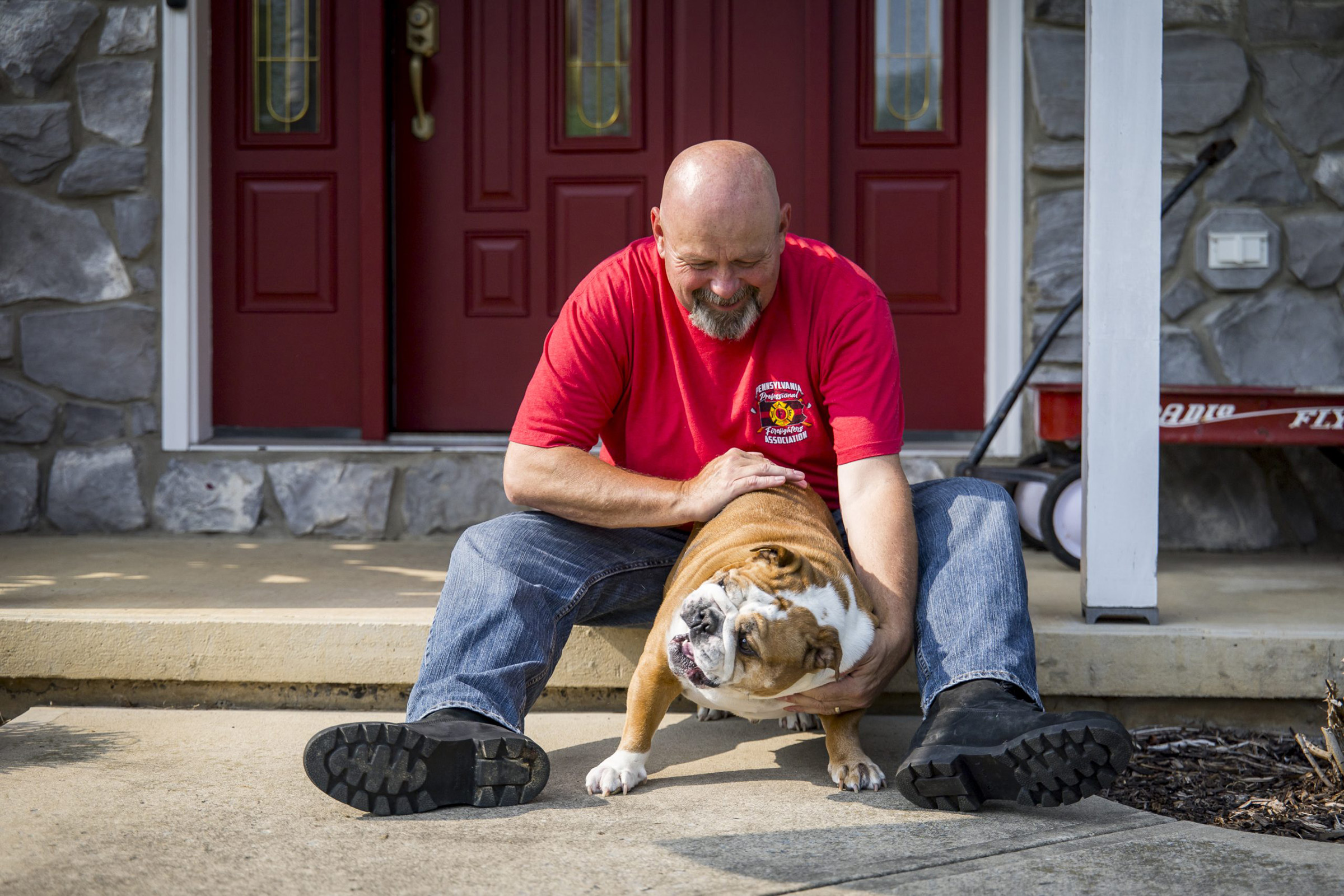
Bob Brooks darted home after a morning of campaigning, swapped a button-up for a bright blue Brooks Lawn Care hoodie and climbed into his salt truck. Snow was forecast that night, and the congressional candidate was determined to salt a few lots before his next afternoon meet-and-greet. “It’s not gonna be a lot, but it’s gonna be sloppy,” Brooks said as the salter stirred to life.
[time-brightcove not-tgx=”true”]
The 53-year-old owns a lawn care and snow-removal business, heads the Pennsylvania Professional Fire Fighters Association, and was recruited by Democratic Gov. Josh Shapiro to win back one of the most competitive House districts in the country. Joe Biden carried Pennsylvania’s Seventh District in 2020 before Donald Trump flipped it in 2024. Two years ago, freshman Republican Ryan Mackenzie won the district by a single percentage point. And here in the Lehigh Valley, as nationally, the party’s chances of regaining the Houses may rest in the callused hands of candidates like Brooks, who are flaunting their blue-collar bona fides in hopes of winning back lower- and middle-income voters who drifted to Trump in droves.
Bald and goateed, Brooks doesn’t have a college degree and touts that as a credential on the campaign trail. (Only three Democrats serving in the House didn’t graduate from college, despite about 40% of Americans fitting that profile.) His campaign launch video shows him riding a Bobcat tractor in his backyard and ticking through the odd jobs he’s worked: dishwasher, pizza-delivery driver, bartender, truck driver, firefighter. “People are lost and they don’t think anybody’s representing them,” Brooks told me as we rode in his salt truck on Feb. 15. “They’re looking for working-class people who understand them.”
If 2018 was the Democrats’ year of the woman, 2026 may be the year of the tatted-up tough guy. Oyster fisherman Graham Platner is running for Senate in Maine. Dan Osborn, an industrial mechanic, is running for Senate as an independent in Nebraska, while former Secret Service agent Logan Forsythe talks about growing up in poverty as he campaigns for the Democrats’ Senate nomination in Kentucky. Before recently dropping out, military veteran Nathan Sage was running for Senate in Iowa as a “tattooed, hairy, fat guy who says it how it is.” It’s not just men, either. Kaela Berg, a single mom and flight attendant, is currently running for congress in Minnesota. JoAnna Mendoza, a retired US Marine who grew up on a farm, is running for an Arizona House district.
After years of hemorrhaging working-class voters to Trump—while bumping up against the ceiling of their share of college-educated suburbanites—Democrats are trying to compete harder for voters who feel culturally alienated and economically squeezed. “The Democratic Party is at its best when it’s fighting for working-class people against the powerful,” says Tommy McDonald, an ad maker with the FIGHT Agency, who is working with Brooks and Osborn and previously cut ads for John Fetterman’s Senate campaign. “This year we have a chance to run actual candidates who experience the impact of the policies made in D.C., who can speak to the lives of the people they are trying to represent and the challenges they’ve faced.”
In some cases, the brash newcomers recruited to serve that purpose come with baggage. Platner apologized in November for past online posts in which he referred to himself as a “communist,” criticized police, and called rural, white Americans racist and stupid. He also covered up a tattoo on his chest that had a Nazi association. Brooks has taken heat from a local blogger for pro-gun social-media posts, as well as one in 2019 in which he called then-NFL quarterback Colin Kaepernick a “douchebag” for kneeling during the national anthem. As Brooks jostles in a crowded, six-way field ahead of the Democrats’ May 19 primary, he is dealing with questions about whether a résumé forged outside government would translate to success in Congress. But his background and laser focus on economic issues has won him the backing of national and state party leaders, from Shapiro—who Brooks said convinced him to run— to Sen. Bernie Sanders and former Transportation Secretary Pete Buttigieg.
“Bob Brooks is a firefighter who has spent his life standing up for working people and running towards danger to keep Pennsylvanians safe,” Shapiro said in his endorsement, calling him “the fighter we need in Congress.”
‘One of Our Own’
At the monthly Teamsters Local 773 meeting in Whitehall Township, President Dennis Howard paused official business to introduce the bald guy standing in the back. “Bob Brooks was a Teamster who used to deliver our most precious cargo—beer,” he said, drawing chuckles from the members. The union doesn’t usually wade into primaries, Howard told them. “But Bob is one of our own.”
Brooks grew up in northern Massachusetts, raised by his mom in a small house that went up in flames the night before his final high-school football game. He was at a school dance when someone told him about the fire; he remembers the orange glow in the distance. A few miles away, firefighters were hosing down what was left of their home. By morning, everything was gone. Brooks borrowed a pair of too-tight football pants and played anyway.
After the fire, he and his mother moved to the Lehigh Valley to start over near family. As a young adult, Brooks cycled through a dozen odd jobs to make ends meet. He says those years—and, later, two decades as a firefighter and union leader lobbying in Harrisburg—taught him how to talk to Republicans and Democrats alike and cut to the heart of an issue. As strategists parse the disappearance of the working-class Democrat, candidates like Brooks say they can channel the frustrations of the people who’ve left the party: union members sold on promises of lower prices, better opportunity, and a break from elites more focused on cultural fights than kitchen-table concerns.
Some of the rougher chapters of his life—the moments that might show up in opposition research — Brooks brings up himself, including two foreclosures while his ex-wife faced steep medical bills from hip deterioration. “I’ve made mistakes in life,” he told the Teamsters. “I had to make doctors’ payments, or I had to make house payments. I made doctors’ payments and got her healthy. Nobody should have to make that decision.”
‘My story is also of struggles’
Not everyone is sold on Brooks’ working-class-hero pitch. His run has drawn frustration from party leaders who feel the Democratic establishment is overlooking other qualified candidates. Northampton County Executive Lamont McClure and former DOJ federal prosecutor Ryan Crosswell are also running.
The district’s last Democratic representative, Susan Wild, endorsed Carol Obando-Derstine, a former staffer for Senator Bob Casey and engineer at PPL Electric Utilities. Wild bristles at what she sees as the national party intervening in the primary to sideline a Latina candidate in a heavily Hispanic district.
“The Democratic establishment is always talking about diversity and representing all sectors of a community,” Wild says. “They’re presented with a Latina, highly qualified, highly educated candidate in a district with a large Hispanic population, and I can only surmise they decided maybe PA-7 wasn’t ready for this kind of candidate.” The district is deeply working class, Wild says, but to fixate on that is too narrow. “This is their new mantra—we’ve got to get the working-class back, so all of our best candidates are these working-class dudes,” she says. “Probably even more important to the outcome of a race are suburban women. So hey, what about them?”
For her part, Obando-Derstine notes she’s the daughter of Colombian immigrants, and the only working mom in the race. “My story is also of struggles and empty wallets and sacrifices with the addition, that others don’t have, of language barriers,” she told me.
But in a sign of how potent Democrats believe the working-class brand to be, one of the sharpest recent attacks on Brooks has been that he isn’t as blue-collar as he claims. A recent financial disclosure estimated his and his wife’s assets at between $148,000 and $3.89 million, according to reports filed with the FEC on Jan. 28. Mackenzie, who sponsored legislation to ban members of Congress or their spouses from owning stocks, called Brooks “a con man who is pretending to be working class.”
“Bob Brooks is selling the same failed policies but he and his political consultants are trying to wrap it up in a working-class package, and it’s gonna fail,” Mackenzie told TIME.
Because assets are disclosed in broad ranges, Brooks says the filing overstates his family’s financial position. “If I was a millionaire, I would not be running for Congress right now. Or I’d be self-funding,” he says. (The investments listed on the disclosure, Brooks says, are part of his wife’s retirement savings — built over 36 years and totaling roughly $600,000.) He tells me this from the driveway of his three-bedroom Colonial, where three trailers sit lined up in the backyard. Asked about them, Brooks says they’re a cheaper mode of storing his snowmobiles and extra plowing equipment than paying for the permits to erect a shed.
A few hours later, at a house party for Brooks hosted by a fellow firefighter’s mother in Ephrata, the candidate talked shop with another plow driver in between shaking hands with a retired electrician and a former police chief. Eventually, the host gathered everyone around the fireplace in the living room for Brooks to give his pitch and take questions. Brooks cautioned that he wouldn’t have all the answers — a recent curveball he got from a college student about artificial intelligence had really stumped him, he recalled.
“Up until March, I was a firefighter. These topics weren’t top-of-our-list,” he says. “I know you get fed lines of s–t all the time. I’m not perfect,” he adds. “I’m not polished by any means. I don’t wanna be polished. I just wanna be me, and represent you.”