

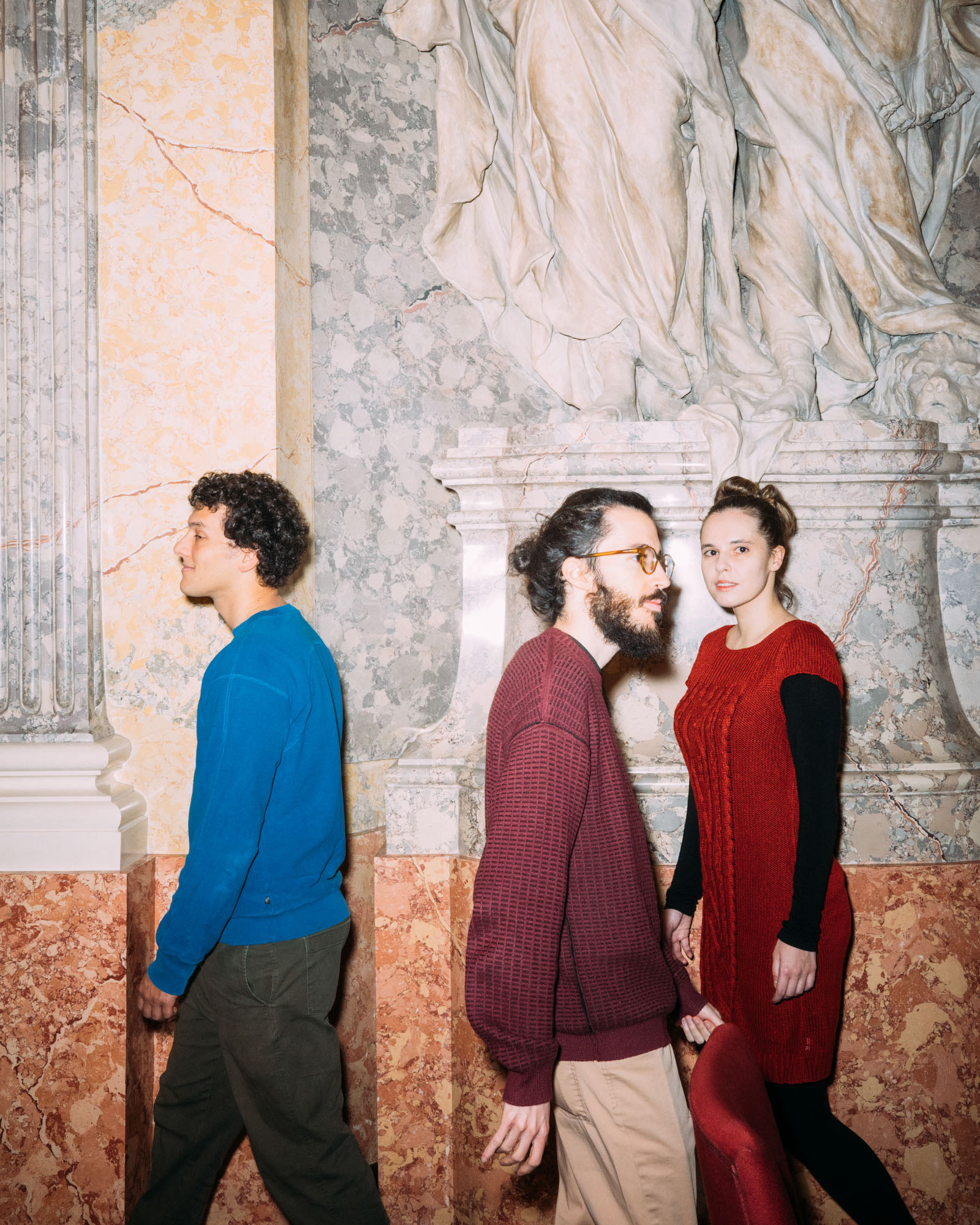
It all started promisingly enough. French biologist Gabriela Lobinska had enjoyed her Ph.D. training, researching how organisms change over time. Arriving at Harvard Medical School in September 2024, she hoped for more of the same. She planned to look at how, over the course of a lifetime, healthy cells change into diseased ones.
[time-brightcove not-tgx=”true”]
Donald Trump won the presidential election shortly after her arrival, and before long, things went downhill. In the spring, the grant paying her salary—along with thousands of others—was cut. In April, the White House proposed cutting by 40% the budget of the U.S. National Institutes of Health (NIH), which is the largest public funder of biomedical research in the country. Then the government withdrew Harvard’s ability to provide visas for international researchers like Lobinska. While a court allowed Harvard to sponsor visas for the time being, Lobinska was questioning why she was in the U.S. “There are places where I could go to do science,” she recalls thinking, “without all this.”
Soon she had a job offer from AITHYRA, a new institute for biomedicine and AI in Vienna. And when she heard of a new Austrian fellowship called APART-USA—specifically for people leaving American institutions, with a generous four years of research funding—she applied, and got it.
Now, she lives in the city where, before Vienna’s scientific community was devastated by World Wars I and II, blood types were discovered, cosmic rays were first identified, and psychoanalysis was born. All around her are architectural remnants of those heady days, like the 1910 Art Nouveau observatory on the edge of the Danube Canal—reminders that a place’s status as a scientific powerhouse is only as secure as the geopolitics that surrounds it.
Read More: Why Michael J. Fox Sees Parkinson’s as a ‘Gift That Keeps on Taking’
Lobinska is just the kind of scientist that Heinz Fassmann, president of the Austrian Academy of Sciences, hoped to lure to Austria with the APART-USA fellowship. He saw the instability in the U.S., while regrettable for science, as an opportunity for Austria to reclaim some of this scientific glory. If the U.S. keeps cutting budgets, he says, we will keep scooping up the good people. By September 2025, 25 candidates had been accepted, including Lobinska.
The APART-USA fellows weren’t the only ones looking beyond U.S. borders. Nature, a leading science journal, reported in April 2025 that through the job board it maintains, “U.S. scientists submitted 32% more applications for jobs abroad between January and March 2025 than during the same period in 2024.” U.S. page views of job postings abroad also spiked: “In March alone, as the administration intensified its cuts to science, views rose by 68% compared with the same month last year,” Nature wrote.
It goes on. In May 2025, the E.U. granted 500 million euros in funding for the “Choose Europe” initiative, intended to help draw international researchers. In April, the president of Germany’s Max Planck Society announced the Max Planck Transatlantic Program, stating it will include roles for researchers who are looking to leave the U.S. The French government also revealed 100 million euros in funding to attract international scientists.
“The United States profited from the migration flow of highly qualified persons, decades after the Second World War,” Fassmann says. “And now, it’s maybe the first time that we can move around this migration direction—that Europe can profit from the talents that are educated in the United States.”
The U.S. wasn’t always a magnet for scientists. “Hardly anyone in the United States devotes himself to the essentially theoretical and abstract portion of human knowledge,” wrote Alexis de Tocqueville in Democracy in America in 1840. In the late 19th century, Germany was the global leader in scientific research. It would be quite some time before the image of Americans as unimaginative backwoodsmen began to shift, and in the early 20th century, apart from agricultural research, American science was often supported by philanthropy and individual states, rather than by the federal government.
After the Nazis took power in Germany in 1933, however, European researchers—including Albert Einstein, most famously—headed in greater numbers to the U.S. In 1939, just before war was declared, Einstein wrote to President Franklin D. Roosevelt, warning that Germany had the brain-power and resources to create atomic weapons. FDR responded with the Manhattan Project, which employed many fleeing physicists and eventually developed the atomic bomb. Congress had new respect for the possibilities of research after that, and the flow of scientists into the U.S. accelerated.
By the mid-20th century, the U.S. had turned into a haven for international talent. Before the war, American science had been notably less hierarchical than in many European institutions. Instead of having to spend years as an assistant to a senior professor, as in Germany, a young professor in America was largely a free agent, explains Daniel Kevles, a retired science historian at Yale University: “There was a great deal of freedom to do what you wanted.” And after the war, European science lay in shambles; there was no comparison between what awaited European scientists in the U.S. and what they could do at home.
The U.S. also had an unusually large system of nationally funded labs, notable for their dedication to basic research. The peculiar openness of American society—scientists could bring their families and become citizens—added to the appeal, says Catherine Westfall, a science historian now retired from Michigan State University.
Read More: The New Way to Predict Your Risk of a Heart Attack
This was part of a particular mindset in the government, explains sociologist of science Olof Hallonsten of Sweden’s Lund University. “You maintain a big brain trust in the universities, in these big research centers, and you let people do more or less what they want,” he says, “because when the time comes that this whole brain trust needs to be mobilized…we can then pool all these resources into specific problem solving.”
To be sure, American science has had its ups and downs. Senator Joseph McCarthy targeted scientists in his 1950s red-baiting campaign, including prominent figures like physicist J. Robert Oppenheimer. The center of gravity for nuclear physics moved back to Europe after American funding for a new collider collapsed in 1993. And it has never been unusual for researchers trained in the U.S.—American or otherwise—to move abroad, taking a job wherever their particular flavor of science is in demand. But in recent years, U.S. public and private sources were the largest funders of all research and development on the planet, and the country was a net importer of scientists. For many scientists, the U.S. had become a hub, where many were educated and hoped to stay.
Now, that status may be shifting. Italian physicist Andrea Urru moved to the U.S. in 2023 to work on magnetism at Rutgers University. He was considering the possibility of securing a faculty position in the U.S., at the same time that he looked at jobs closer to home. “Developing an academic career in this country would be absolutely great,” he says. However, after the National Science Foundation, a major funder of basic science, came under threat from government cuts last year, that option “became even fainter, and I decided to direct my efforts towards getting funds in Europe.” Urru will soon move to the University of Cagliari in Sardinia.
American geneticist Audrey Lin studies evolution using ancient DNA, with a particular focus on how dogs were domesticated. In the spring of 2025, when she was applying, “the job situation in the U.S. was very unstable, with a lot of faculty job searches being canceled or postponed,” she says. But “science doesn’t stop. I’ve spent almost a decade of my life training and working on my research, and this is what I’ve chosen to dedicate my life to. And I have to go where I can do this.” She too is now an APART-USA fellow, and arrived in Austria in February.
Europe likely can’t compete with what the U.S. traditionally spends on science. As a whole, the continent funds about 20% of the world’s research and development, compared with the U.S.’s roughly 29%, according to numbers compiled by the American Association for the Advancement of Science. What’s more, large investments in basic science are usually the purview of a rapidly growing economy, Hallonsten says, which Europe’s is not. “The reason that China has been investing so much in science and technology in the past 20 to 30 years, of course, is that they have the money. They need to invest in something,” he says. “The same thing was true for the United States after World War II.” China now funds around 28% of the world’s R&D, but Hallonsten and other experts aren’t convinced the country will build a similar research environment to that of the U.S. Many researchers moving to China from abroad these days are U.S.-educated Chinese scientists, says Deborah Seligsohn, a professor of political science at Villanova University—people returning home, rather than immigrants.
But Europe can try to provide some of what has historically been appealing about American science. At the Institute of Science and Technology Austria, in the Vienna Woods, new buildings have been springing up like mushrooms of steel and glass, labs where that culture of freedom is being carefully cultivated.
Read More: 8 Phrases That Will Instantly Get Your Doctor’s Attention
Italian biologist Elia Mascolo, who uses information theory to study how genes work, was attracted by the cluster of researchers already at ISTA. Working with specific people was also why he had spent four years in the U.S., and why he might have stayed longer if the right job had come along. But when the APART-USA fellowship was announced, he signed on. “It’s so niche, my research,” he says, sitting in a glass-walled pavilion on the campus, which is studded with quirky public art and bridges between buildings. It’s a common refrain among scientists: they have to go where the funding and support for their specific work is.
What does the U.S. stand to lose, if it is no longer a hub for science? “I think what we’re going to see now is a dispersal of scientific talent, and I think that’s costly, not just to the United States, but to the world,” says Seligsohn. “If you think about a long-term history of global development, there’s usually been a scientific hub when there are a lot of advances, whether that hub was Paris or Berlin or the United States.” As well, work from economists who study technological innovation has found that it increasingly depends on basic science. Since 1975, the percentage of new U.S. patents drawing on federally funded science has roughly tripled, to nearly a third of all patents filed.
What the U.S. gives up, others stand to take. Fassmann says that Austria is not rescuing these scientists—it’s making a calculated attempt to redirect the flow of scientific migration.
Since Trump took office in January 2025, nearly 8,000 research grants have been canceled or frozen, and around 25,000 federal scientists and employees of research agencies have lost their jobs, Nature has reported. The effects are still rippling through American institutions, and the long-term consequences of this upheaval remain to be seen.
However unstable the landscape is for scientists in the U.S., there’s no guarantee of solid ground abroad, either. The world is a tumultuous place. Westfall, the American science historian, attended a recent physics meeting at CERN, one of the world’s largest institutions for scientific research. She sensed that European scientists also did not feel particularly at ease. “Everybody is feeling the insecurity about Russia and Ukraine,” she says, and there are fears that government spending in Europe might increasingly turn toward defense at the expense of funding for science.
The picture in the U.S. continues to be uncertain and hard to read. There have been some changes since Lobinska’s stressful spring: Harvard enrolled a record number of international students in 2025, and Congress has pushed back against the budget proposed by the Administration, refusing many funding cuts to science. In the meantime, scientists continue to have to decide where they are going to take their work, each one making the call on where they think they’ll best be able to thrive.
For chemist Yasin El Abiead, an APART-USA fellow, leaving the U.S. led to a homecoming. He grew up not far from Vienna and was educated there; he spent several years in the U.S. mainly because he, like Mascolo, wanted to work with a particular researcher. “[The U.S.] is where the money is, and that’s what brings more people there,” he says on a cold morning in January in his new lab. “That’s how it rolls. And if that ever turns around…I don’t know.” He sighs.
Finally he puts words to what’s on his mind. “All the greatest researchers used to be in Germany,” he says, and in other parts of Europe. “You can still see many of these old buildings in Vienna…Austria was huge in science.” At the University of Vienna, in the chemistry department, there still stands a lecture hall that looks just as it did when Einstein was photographed attending a lecture there, not all that long before Nazis took over the country.
The U.S. is where people go to do science, for the moment. “But things change,” El Abiead says. “Let’s see what happens.”