

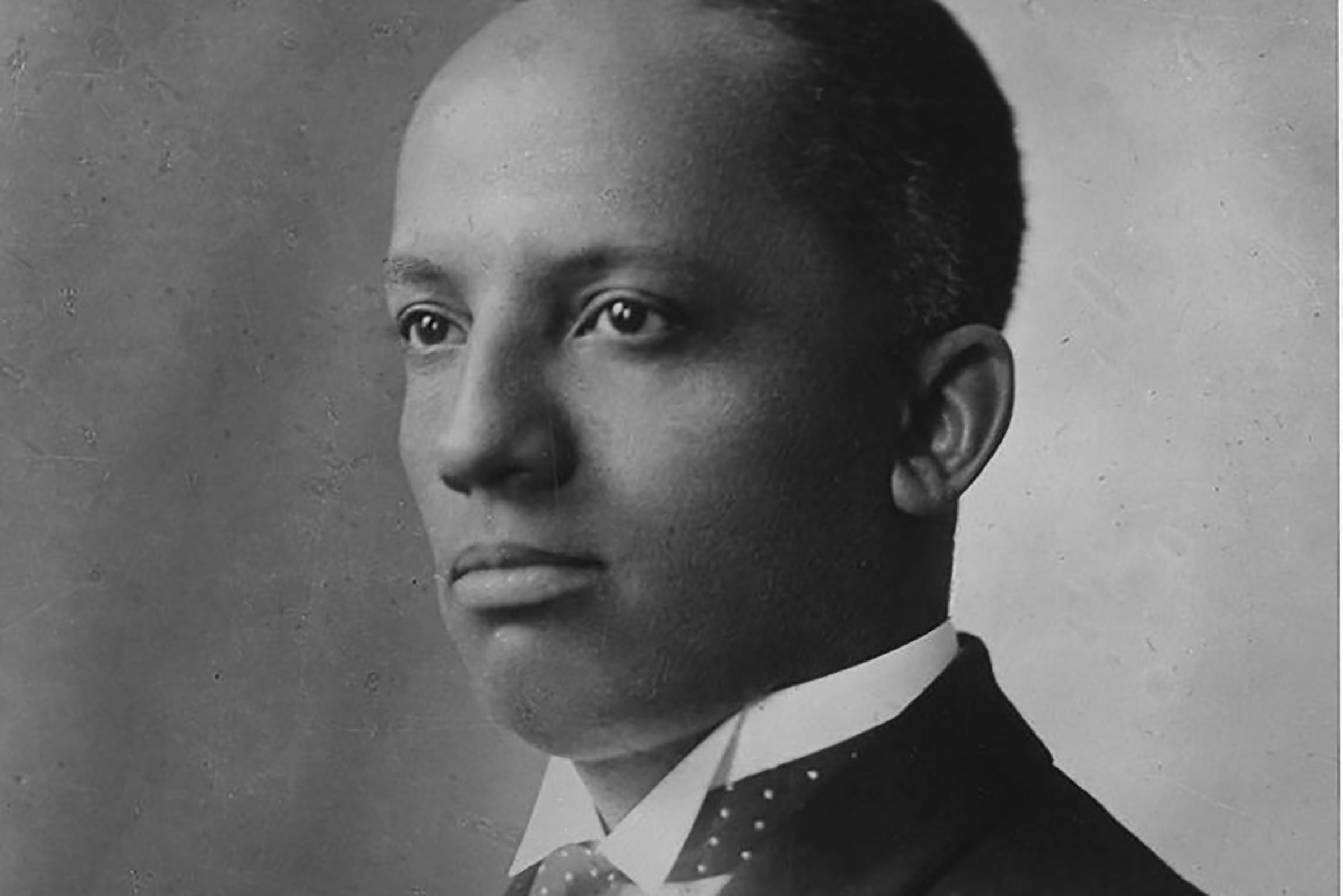
In 1926, Carter G. Woodson launched what was then called Negro History Week. It wasn’t meant as a celebration so much as a correction.
Woodson believed the United States was living with a dangerous distortion: Black Americans were central to the nation’s development, yet largely absent from the way its history was told. He understood the consequences of that omission. When a people are left out of the national story, it becomes easier to leave them out of classrooms, boardrooms, balance sheets, and corridors of power.
[time-brightcove not-tgx=”true”]
History isn’t just memory; it quietly shapes how a country understands itself. It influences policy debates, public priorities, and assumptions about who belongs where.
This year marks the 100th anniversary of what became Black History Month. In 2026, the United States turns 250. Woodson’s message at this moment is not about ceremony. It is about direction.
His own life reflected that clarity. Born in 1875 to formerly enslaved parents, Woodson worked in coal mines before pursuing an education with uncommon discipline. He earned a Ph.D. from Harvard—only the second Black American to do so—not as a symbol, but as a means of claiming intellectual authority in a country that often denied it. In 1915, he founded the Association for the Study of Negro Life and History. A decade later, he created Negro History Week so that Black contributions would be treated not as marginal additions, but as foundational to the American story.
Woodson recognized that invisibility carries consequences. If people are missing from the narrative, it becomes easier to justify excluding them from opportunity, jobs, capital, housing, or leadership.
A century later, that insight feels familiar.
The United States remains the largest economy in the world and among the wealthiest nations in history. Yet tens of millions of Americans live with persistent financial fragility. Many feel that upward mobility is harder to reach than it once was. Some wonder whether the system was designed with them in mind at all.
When large segments of the population feel shut out of the economic story, the effects ripple outward. Distrust grows. Institutions strain. Growth becomes more fragile. This is not simply a moral concern; it is an economic one.
Woodson did not ask for sympathy. He asked for accuracy. He believed the country would be stronger if it told the truth about itself fully and without distortion. A clearer understanding of history, he argued, would deepen confidence rather than diminish it.
American history bears that out. After the Civil War, redefining citizenship reshaped the nation’s trajectory. In the 20th century, women’s expanded participation transformed the workforce and the economy. The Civil Rights Movement opened markets and institutions that had long been closed. Each of those expansions faced resistance. Each ultimately broadened the country’s base of growth.
As the United States approaches its 250th anniversary, we confront a choice about how we define the next chapter. We can treat opportunity as scarce and tightly guarded. Or we can recognize that untapped talent remains one of the country’s greatest competitive advantages.
The stories we tell about who counts tend to precede the policies we build. If we describe millions of Americans primarily as burdens, our institutions will reflect that assumption. If we recognize them as contributors, we are more likely to construct systems that draw on their capacity rather than sideline it.
In an era defined by rapid technological change and intensifying global competition, nations do not decline because they lack tools. They decline when they fail to cultivate the full potential of their people. Countries that waste talent stagnate. Countries that develop it endure.
Patriotism, in that sense, is less about nostalgia than about stewardship. It requires asking whether we are expanding the promise of the country or quietly narrowing it.
Woodson believed that understanding Black history would strengthen America’s confidence in itself. Inclusion, for him, was not sentimental. It was practical. He trusted that the American story could withstand the whole truth.
This year, the question is not whether we celebrate the nation’s founding. It is whether we continue its work. The American experiment has never depended on perfection; it has depended on adjustment, widening the circile and reinforcing the center at the same time.
Woodson adjusted the narrative so a fuller country could emerge. Our responsibility now is similar: to tell a story big enough to include the breadth of American talent, and to build an economy that reflects that belief.
The direction we choose will shape the character of America at 250, whether it is confident or anxious, open or defensive. Woodson offered a model a century ago. The more difficult question is whether we are willing to apply it.