

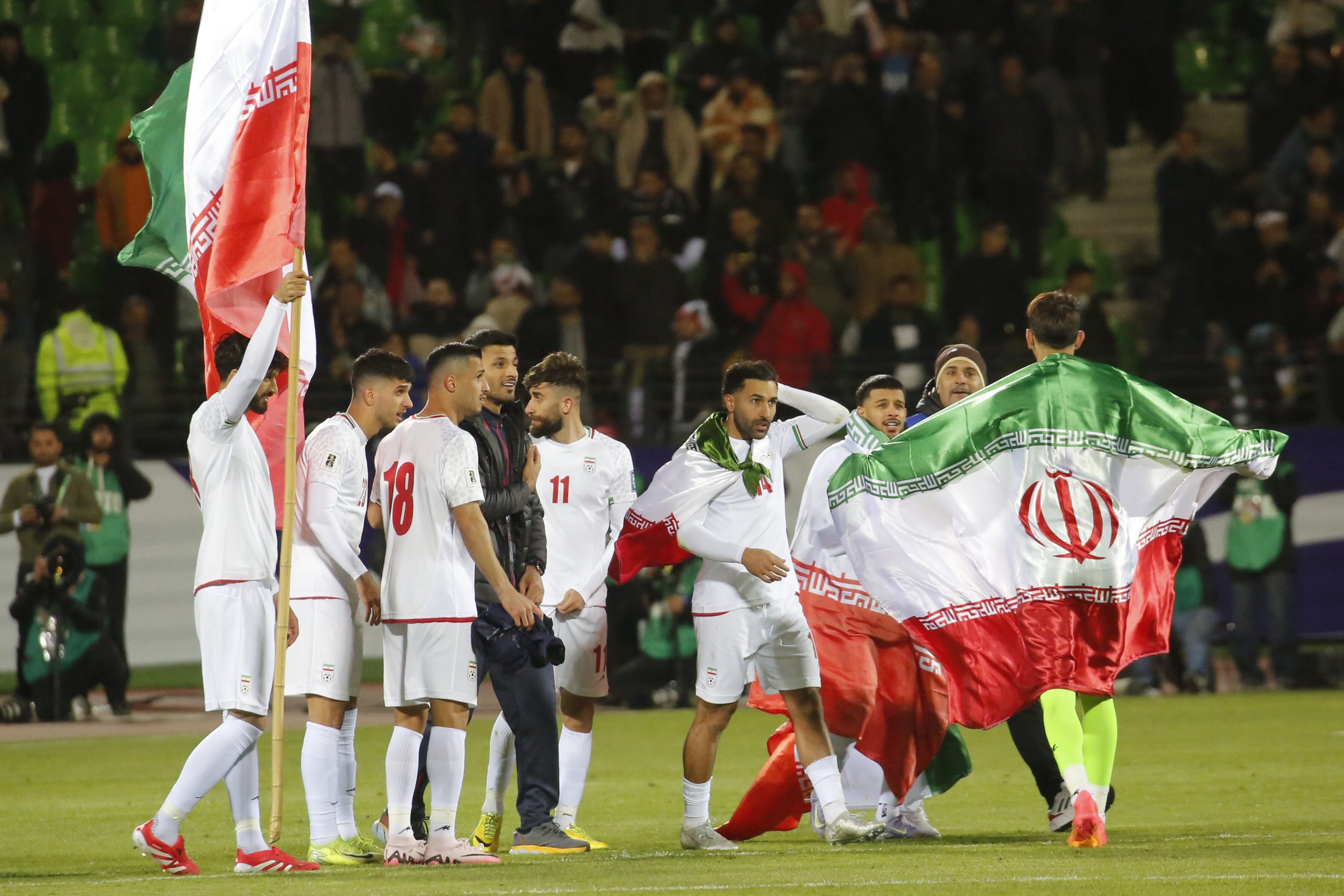
When it comes to geopolitical tensions spilling into the world of sports, the Iran war—now in its seventh day—has no historical precedent.
According to Pacific University professor Jules Boykoff, an expert on international sports politics, a World Cup host country has never attacked one of the tournament’s participants some three months before the beginning of the most-watched sporting event on the planet. “Soccer-wise,” says Boykoff, “it moves us into uncharted territory.”
[time-brightcove not-tgx=”true”]
The military action against Iran initiated by President Donald Trump—winner of FIFA’s inaugural Peace Prize in December—in concert with Israel certainly cast a pall over the 100-day countdown, marked on March 3, to a World Cup that FIFA president, and Trump ally, Gianni Infantino has promised to be “simply the greatest event that humanity, that mankind, has ever seen and will ever see.”
Will Iran be able to, or want to, participate in the World Cup after the U.S.-Israel bombings killed Iran’s Supreme Leader Ali Khamenei, other Iranian political and military leaders, and according to the U.S.-based Human Rights Activists News Agency, more than 1,000 civilians, including 181 children, in the first five days of the war? The country’s games in Los Angeles against New Zealand on July 15, Belgium on July 21, and against Egypt in Seattle on July 26 hang in the balance.
On Monday, Iranian soccer federation president Mehdi Taj was quoted as telling state television: “What is certain is that after this attack, we cannot be expected to look forward to the World Cup with hope.”
Iranian soccer officials did not respond to a TIME interview request.
“Of course, we will monitor the developments around all issues around the world,” FIFA secretary general Mattias Grafström said on Feb. 28. “We had the final draw in Washington, where all teams participated and, of course, our focus is to have a safe World Cup with everybody participating.”
(A FIFA spokesperson declined to comment further: Grafström did not return an email requesting comment. If Iran were to boycott, either Iraq—who faces either Suriname or Bolivia in a playoff on March 31 for one of the final World Cup positions—or the United Arab Emirates, who lost to Iraq in a World Cup qualifier in November, could take its place.)
Andrew Giuliani, executive director of the White House Task Force for the FIFA World Cup 2026, said on Feb. 28: “The largest state sponsor of terrorism in my lifetime is dead. Today’s action by the 45th and 47th President of the United States will make the world a safer place and start a chain reaction of peace. My heart is with the thousands of American service members’ families who were victims of the Ayatollah’s ‘Death to America’ mission. The head of the snake spreading that vile message has now been cut off, and I pray the Iranian people will seize their liberty. We’ll deal with soccer games tomorrow–tonight, we celebrate their opportunity for freedom.”
Giuliani did not respond to a message seeking an interview; a task force spokesperson declined to comment further.
In 2025, Trump suspended the entry of Iranian nationals into the United States. An exemption, however, was carved out for “any athlete or member of an athletic team, including the coaches, persons performing a necessary support role, and immediate relatives, traveling for the World Cup, Olympics, or other major sporting event as determined by the Secretary of State.” So while Iranian players and coaches would be able to travel for the World Cup, soccer fans from Iran would be restricted from coming to the United States. Members of the country’s global diaspora would be counted on to support the team, which in the past has been at the center of political battles.
At the 2022 Qatar World Cup, for example, before a game against Wales, fans supporting the Iranian government clashed with those protesting against the regime. The Iranian women’s team, competing in the Asian Cup in Australia, on Monday declined to sing the national anthem before its match against South Korea, a move that was interpreted by many as an act of resistance against the current regime. On Thursday, however, the team saluted and sang the anthem in the midst of the ongoing conflict in the MIddle East.
Given the Iranian regime’s crackdowns on protests that preceded the war—according to the Human Rights Activist News Agency, that violence resulted in more than 6,000 deaths—some Iranian-Americans don’t think a team that represents a brutal government should appear on the World Cup stage.
“Two years ago, I know Iranian fans would be heartbroken if the team wasn’t sent,” says Abbas Milani, director of Iranian studies at Stanford University. “Today, I think they will be angry at the athletes who would want to represent Iran in such a moment of calamity.”
Others want Iran to play, and are especially eager to support the soccer players in this charged atmosphere. They don’t equate the team with the regime.
“There’s tons of people in the U.S. right now that hate Trump with a passion, but nobody is saying this is Trump’s team that’s playing in the World Cup,” says an Iranian-American soccer fan, who asked to remain anonymous for fear of backlash within the diaspora. “These are young kids that are in their 20s, that have dedicated their life to the sport. I feel nothing but proud when they do well.”
Iran’s participation in the World Cup probably has no real downside, for any parties in the conflict.
“In a perfect world, the team comes here and plays because being connected to other people, and being connected not as the subjects of governments who have issues, but just as members of the human family, is important,” says Jamal Adbi, president of the National Iranian American Council. “That’s important politically, too. Because when you know who you’re bombing, you’re less inclined to bomb them.”