

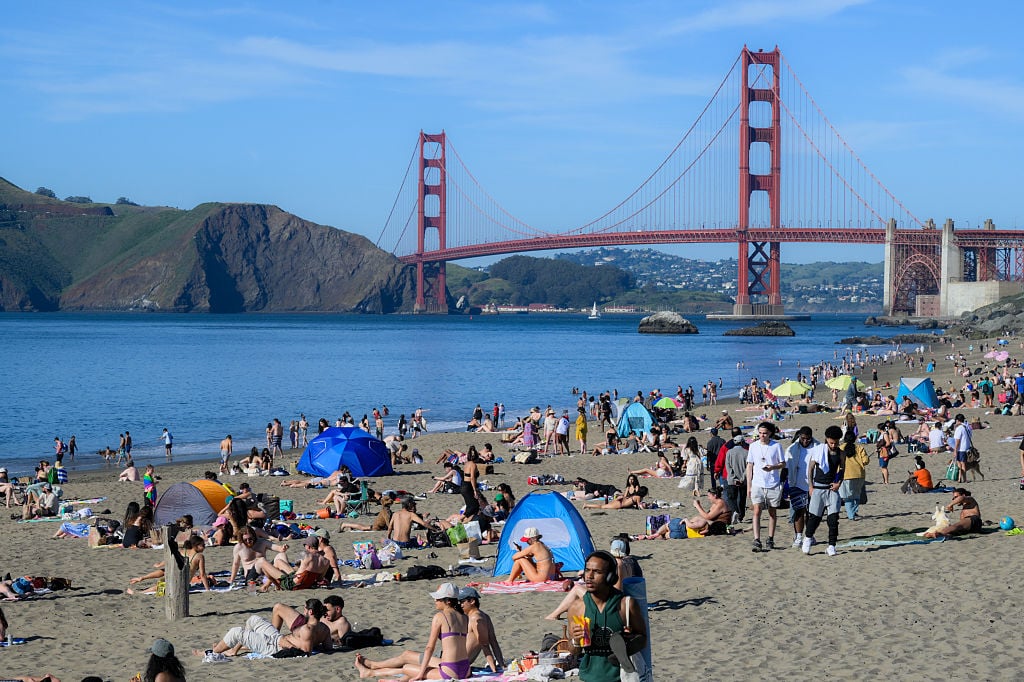
A historic March heat wave has brought record-breaking temperatures to almost 180 cities from the Midwest to the West Coast.
Last weekend, parts of the Great Plains were as much as 45°F warmer than average. California and Arizona both saw 112°F highs, while Colorado, Nebraska, and Missouri all saw temperatures reach the mid 90s.
Across the west, relief isn’t in sight yet, with scorching temperatures expected to continue over the coming days. Warm temperatures are also expected to move east in the coming days. It begs the question: how rare is this and how is climate change making heat waves worse?
What causes a heat wave?
A heat wave is defined by the National Oceanic and Atmospheric Administration as a period of unusually hot weather that lasts two or more days. To be considered a heat wave, the temperatures have to be outside the historical averages for a given area.
They form when high pressure systems trap warm air in a particular area. This forces air to sink and compress, creating a dome of heat, which increases temperatures at the surface.
Why do heat waves seem to be happening more often?
Scientists have long understood that human-induced climate change would cause the Earth to heat up.
“We always knew that climate change was going to bring more extreme heat days, and that was going to start earlier in the year,” says Dr. David Eisenman, professor of medicine at UCLA whose research focuses on the public health impacts of extreme heat. “And I think we’re seeing that now.”
The trend has become especially apparent over the last few years. Global temperatures from the past three years averaged more than 1.5°C above the pre-industrial level, and the last decade has been the warmest on record. (One or two years of global temperatures above 1.5°C does not mean the world has passed the Paris Agreement goal to limit warming to 1.5°C. Scientists determine long-term temperature changes on timescales of decades.)
While it might not seem like much, even incremental increases in global temperatures have a big impact on our climate. “When we talk about climate change increasing the average temperature by one and a half or two degrees, that really doesn’t tell us everything,” says Eisenman. “What really happens is that it shifts a curve of the probability of extreme heat days. So [instead of seeing], say, 90 degree [days] only 5% of the time, it now starts to happen 10 or 15% of the time. These extreme heat days are just the natural result of shifting the average temperature by even a small number of degrees.”
How will climate change impact future heat waves?
Climate change stands to transform the four seasons as we know them now, lengthening the summer season and shortening winters. While what this looks like will vary depending on where you live, we will all see warmer days, and seasonal changes could alter the growing seasons for plants and migration patterns for animals.
Though T-shirt weather in March might feel jarring now, climate change means that the days of bulky sweaters and warm coats in early spring might soon feel like a thing of the past.
As Eisenman says, “10 years ago, we might have called this very abnormal but we have been learning in the last couple years that this is no longer abnormal.”