

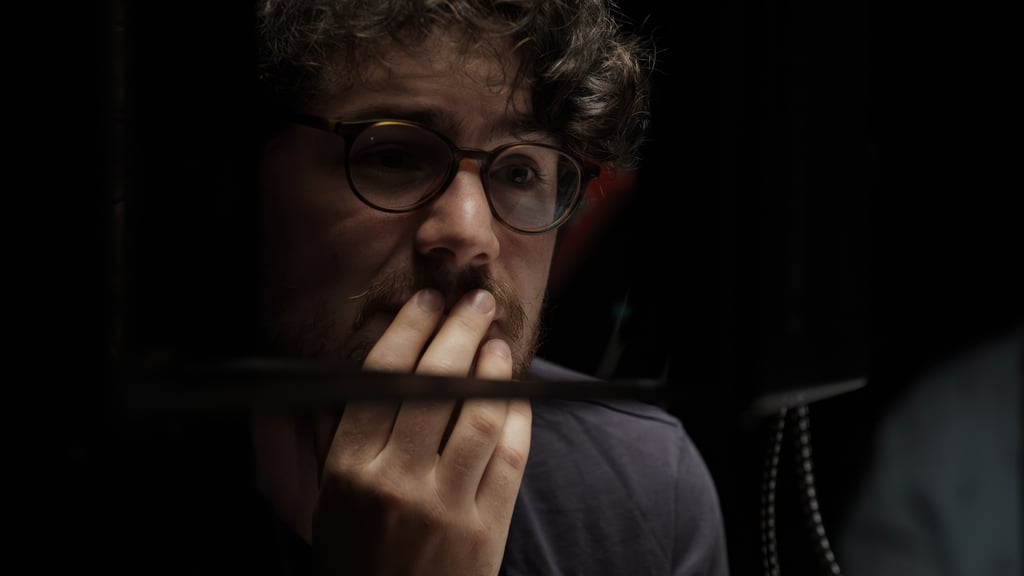
In 2023, around the same time that director Daniel Roher began working on a film about AI and the future of humanity, he and his wife Caroline found out that they were having a baby. Making a 90-minute film about a “huge, important, gargantuan” like AI had felt “almost impossible,” says Roher. But the birth of his family’s first child provided a way to ground the film.
“People can relate to babies. People love babies!” Roher said on a Sundance Film Festival panel.
The AI Doc: Or How I Became an Apocaloptimist evolved into the story of a father-to-be seeking out experts and top AI CEOs to understand where the technology is headed, with Roher and his wife at its center.“I didn’t love it,” he says. “[But] I guess I’ve been training my whole life to play a little peabrain in a movie.”
The AI Doc’s approach of examining an abstract topic through a personal story echoes Navalny, Roher’s Oscar-winning 2023 documentary, which presented the terror and dysfunctional comedy of the Russian state through a snapshot of the life of opposition leader Alexei Navalny and his family. As in Navalny, it’s an effective strategy. The film’s most powerful moments intertwine Roher’s emotional journey with his on-screen conversations with researchers.
“I have this baby on the way,” Roher tells Tristan Harris, whose 2023 talk on the “AI Dilemma” inspired the movie. “Are we doomed?”
“It’s not good news,” replies Harris, looking visibly affected, before the camera cuts away.
But AI, and its impact on society, is too complex to be told from the perspective of a single person. So the movie enlists a few dozen experts in a series of interview clips that, spliced together with illustrative B-roll over the top, form the visual backbone of the movie.
This includes the doomers, who think that AI will kill everyone, as well as the utopians, who hold that AI will usher in a new era of human flourishing. (It is a little disconcerting that the doomsayers include a godfather of AI, an inventor of ChatGPT, and the chief AGI scientist at Google DeepMind—while the optimists are represented by a physicist who got famous on Twitter and the founder of LinkedIn.) Even the people who think that AI is overhyped make an appearance, although mostly as a footnote—which, unsurprisingly, they didn’t appreciate.
The intention, says producer Ted Tremper, is to provide a smorgasbord of perspectives that allows viewers to “go on their own adventure.”
The AI Doc’s big ticket stars are the CEOs leading the race towards artificial general intelligence: Sam Altman of OpenAI, Dario Amodei of Anthropic, and Demis Hassabis of Google DeepMind. The AI Doc has an opportunity to show these celebrity technologists in a new light—but making powerful people speak candidly or say novel, interesting things is not easy. “Sam [Altman] is sitting on the precipice of being one of the most powerful men in the world,” says Roher. “He’s not going to be derailed by saying something stupid to some schmuck.”
In a movie about the ways that the future will be shaped by individual choices, the character of these individuals—two of whom recently refused to hold hands at a press event—is of critical importance. “I made a Terminator joke that [Sam Altman] … did not have the sense of humor about, let’s say,” recalls Roher. The scene didn’t make the cut. Instead, the CEOs spend most of their time on screen reciting talking points.
In Tremper’s telling, the unsatisfactory nature of the CEOs’ appearance is deliberate: a way to show that even the people at the top have no plan. “It’s very important that the film doesn’t choose favorites in terms of which CEO we like because they’re all culpable to a different degree,” he says.
The AI Doc is a story of competition between rich, powerful companies and rival nations driving humanity towards an uncertain future. “The path we are on—it does not look good,” says Tremper. In the months since the film wrapped, AI models have been deployed in war zones to identify bombing targets, and the U.S. government retaliated against a leading AI company after it refused to remove red lines prohibiting the use of its technology for mass surveillance.
But the documentary is also a story of hope, inviting viewers to acknowledge the unpredictability of the future and take ownership. Since making the movie, Tremper has become the interim executive director of the Creators’ Coalition on AI, aimed at uniting the creative industry in the face of Big Tech. Roher recently canceled his ChatGPT subscription after OpenAI signed a deal with the Pentagon. And The AI Doc itself, which follows in the tradition of movies such as The Social Dilemma and An Inconvenient Truth, is an attempt at shifting course, three years in the making.
“I’m doing what I can in my own life as a filmmaker and a father and a husband to try and just ever so slightly bend the arc of this thing away from the predetermined result,” says Roher.