

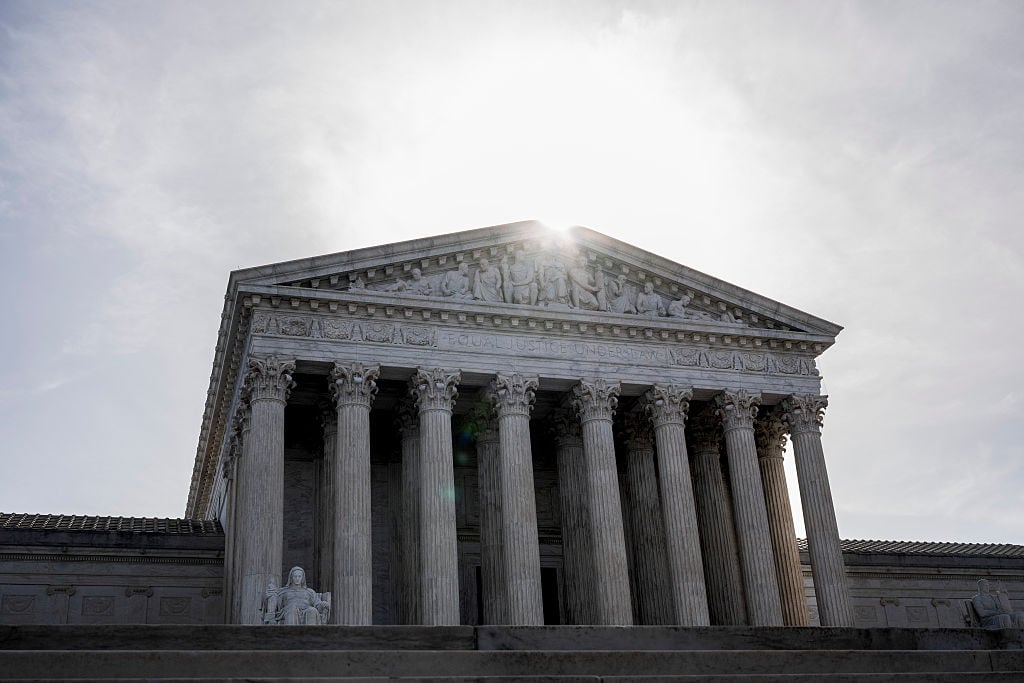
President Donald Trump is trying to end the constitutional guarantee of birthright citizenship for children born in the United States. The Supreme Court will hear arguments in Trump v. Barbara, the ACLU’s lawsuit challenging his unconstitutional and profoundly un-American efforts April 1.
If the Court rules in his favor, the consequences for immigrants and non-immigrants alike would be devastating. Unfortunately, our nation’s history offers a chilling preview of what would happen if the Court fails to defend the 14th Amendment.
Signed by President Trump on the first day of his second term, Executive Order 14160, is titled “Protecting the Meaning and Value of American Citizenship,” but it would have the opposite effect. The executive order attempts to exclude many children born in the U.S. to non-citizen parents from the 14th Amendment’s guarantee of birthright citizenship. This would include children born to long-term work and educational visa holders, DACA recipients, and people with humanitarian protections.
We need not look any further than the history of free Black people prior to the passage of the 14th Amendment to see what would happen were this executive order to stand. In antebellum America, free Black people were forced to carry papers around to prove their freedom and fight attempts to be kidnapped into slavery.
The Supreme Court’s infamous 1857 decision in Dred Scott v. Sandford made the precarious position of free Black people even worse. Delivered by Chief Justice Roger Taney, the Court marked free Black people as a “separate class of persons” and thus subject to discriminatory laws, harassment, violence, and even deportation.
As Justice Taney wrote, “[Black people] had for more than a century before been regarded as beings of an inferior order, and altogether unfit to associate with the white race, either in social or political relations; and so far inferior, that they had no rights which the white man was bound to respect.”
Fortunately, the 14th Amendment, one of three Reconstruction amendments to the Constitution, rejected the Dred Scott decision, guaranteeing citizenship to formerly enslaved Black people. The broader goal of the amendment’s birthright citizenship clause was to settle citizenship once and for all, ensuring that no one person could deny the full rights and privileges of American citizenship to children born and raised here.
Indeed, the congressional record shows that in 1866, U.S. Senators specifically debated whether the birthright citizenship clause should apply only to formerly enslaved Black Americans or to all persons born in this country and subject to its jurisdiction, including the children of immigrants. On the question of immigrants, the Senators concluded that “Most assuredly they would be citizens of the United States.”
Framers of the Citizenship Clause explicitly chose to ensure that babies born in the United States would be citizens, without regard to the race or status of their parents. This principle was reaffirmed in 1898 in United States v. Wong Kim Ark, where the Supreme Court ruled that children born in the United States to immigrant parents are citizens under the Constitution, rejecting the idea of second-class status and upholding the 14th Amendment’s guarantee of birthright citizenship.
Of course, no President can unilaterally overturn the clear language and intent of a Constitutional Amendment. But that has not stopped President Trump from trying to reverse one of the greatest civil rights wins in our nation’s history and reincarnate a Dred Scott-esque future for hundreds of thousands of families.
Already, in communities across the U.S., we see attempts to return to the pre-14th Amendment “show me your papers” society. Already, people are being subjected to increased racial profiling in our schools, hospitals, and neighborhoods.
Yes, this is about how our government treats immigrants. But that is not the extent of the harm. History tells us that not all people born on U.S. soil will be treated equally.
Consider a plaintiff in an ACLU lawsuit challenging the Trump Administration’s anti-immigrant actions in Minnesota. After being stopped by ICE, he told them repeatedly, “I’m a citizen. I’m a citizen.” DHS agents told him “that don’t matter,” refused to look at his proof of citizenship, and drove him to an ICE building in south Minneapolis. Agents grabbed another witness in the lawsuit out of his car at a gas station, handcuffed him, and when he said, “I’m an American citizen,” they replied to him, “Why don’t you go back to your country?”
In Florida, the ACLU represented a man named Peter Sean Brown—a Black, natural-born U.S. citizen—who was unlawfully detained and nearly deported as a result of ICE’s collaboration with a Florida sheriff. While he wasn’t deported, we’ll likely see more cases like his if President Trump is successful in his attempt to end birthright citizenship.
The America President Trump is working to create—one where a child’s citizenship is dictated by their parents’ immigration status, not where they are born and raised—could compound this chaos. Revoking birthright citizenship would invite even more discriminatory assumptions about who is—and isn’t—“really” American. Ultimately, the President’s executive order threatens to create a caste system, or, in Taney’s words, a “separate class of persons.”
On April 1, ACLU National Legal Director Cecillia Wang, herself a second-generation American, will argue our case, Trump v. Barbara, before the Supreme Court, asserting that President Trump’s attempt to end birthright citizenship is a violation of the 14th Amendment.
We and our partners will fight to defend the Constitution and ensure that future generations can enjoy their constitutional right to birthright citizenship—a promise born out of Reconstruction and one our country cannot afford to break now.